top of page
HOLY TRINITY LUTHERAN CHURCH
Stained Glass
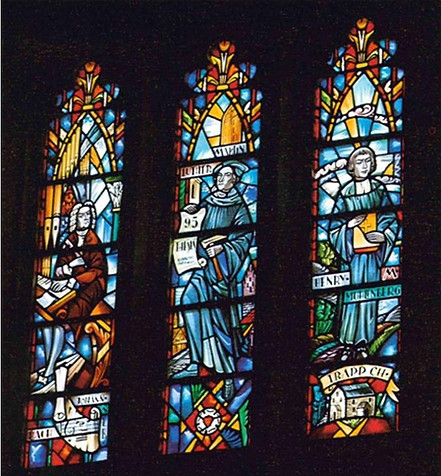
Clerestory Window (east side)
First Unit Group
Three Great Men of the Lutheran Church
Johann Sebastian Bach
The third lancet, (first on the left) is dedicated to Johann Sebastian Bach whose great compositions were devoted to the Church. He was a great organist and composer. He was born in Eisenach, Germany, in 1685. His family had been musicians for several generations. At an early age he became a singer, and then violinist, in St. St. Michael's Church, Luneburg. His music is considered real glorification to God and is accepted by all Christian Churches in the world.
Martin Luther
The main figure is Martin Luther, who in the central lancet (middle) is depicted standing in front of a church door ready to put up his "95 Theses." The symbol of Lutheranism is the mystic rose with a red heart and cross in the center. Luther's rose is accepted as a seal of the Lutheran Church.
Henry M. Muhlenberg
The figure on the right depicts Henry M. Muhlenberg, called the father of the Lutheran Church in America. He is shown holding a Bible in his hand, symbolizing the spread of Lutheranism in this country. A picture of the Trappe Church, which still stands as a living message, can be seen in the lower portion of the window.
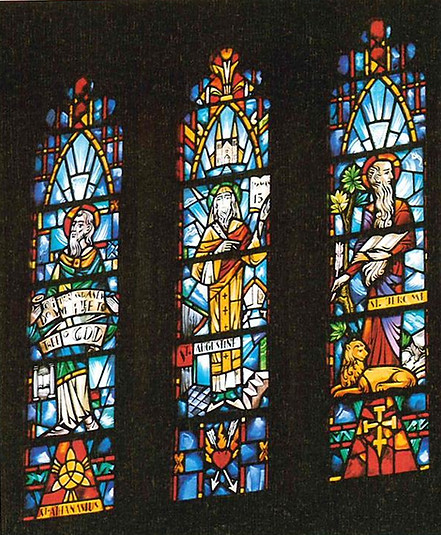
Clerestory Window (east side)
Second Unit Group
Early Church Leaders, who clarified
and stated Christian principles and influenced Martin Luther.
St. Athanasius
St. Athanasius (first on the left), bishop of Alexandria, known as the "Father of Orthodoxy" because of his valiant defense of the doctrine of the Trinity against the Arians, was born in Alexandria in 296 A.D. Although he did not write the Athanasian Creed, one of the three great creeds accepted by all Christians, his terse, simple statements of New Testament teaching later took shape and eventually became known as the Athanasian Creed. He suffered terrible persecution. His symbol of Trinity can be seen the lower portion of the window.
St. Augustine
St. Augustine (middle) is the main figure in whose writings and statements Martin Luther found sound principles to build up Lutheranism. He was a celebrated bishop who was born in Tagaste around 354 and lived until 430. Through the influence of his mother, and St. Ambrose, he was led to Christianity. His "Confessions" remain to this day one of the famous writings of the ages. He became a champion of the church, contending against the heresies of the Manichaeans, the Donatists and the Pelagians His most common symbol is a heart surmounted by heraldic flames, symbolic of zeal. The heart is pierced by two arrows, signifying his remorse for the iniquities of his youth.
St. Jerome
St. Jerome (right), forerunner of the Latin or Western Church fathers, was born about 340 in Stridon. He is best known for the important part he took in the translation of the Bible into Latin. A lion is invariably pictured at his side. It is said that at one time he came upon a lion which was suffering from infection due to a large thorn in its foot. Jerome extracted the thorn and dressed the wound. The beast licked his hands in gratitude. Thus the lion has become a familiar symbol of the saint. Another common symbol is a Cross Potent, pictured in the bottom panel.

Clerestory Window (east side)
Third Unit Group
Christian Leaders
St. Timothy
St. Timothy (first on the left), is one of the earliest followers of St. Paul, who continued the work of organizing and building up Christian Churches among the people of the ancient world. He went among the people of Greece and through his efforts, worshippers in pagan temples became followers of Christ. He introduced one God and His only Son, Jesus Christ, to them. Very soon pillars of temples were crumbling and made possible Christian Churches to be built on their ruins. The symbol of the burning lamp represents Christian knowledge and the flames behind the figure of St. Timothy represent the gifts of the Holy Spirit as a promise of God in Jesus Christ coming down from heaven to fill the hearts of the people.
St. Paul
St. Paul (middle) in the beginning was willing to persecute the Christians and try to destroy Christ and His followers, but became one of the most faithful soldiers for our Lord, Jesus Christ when at Damascus he was awakened and heard the voice of Christ saying, "Saul, Saul, why do you persecute me?" and he said, "Who are you, Lord?" "I am Jesus, whom you are persecuting." (Acts +9:5-7). From that moment he stood up and went from land to land telling about Christ. We see a sword and an open book with the inscription, "Spiritus Gladius" - Latin for "Sword of the Sprit." Above his head can be seen a sailboat, symbol of the Christina Church. The body of the ship is called the nave, the main part of the Church where all people worship together, similar to man being on one sailing boat.
St. Stephen
St. Stephen (right), was one of the first martyrs who experienced great passion spreading the word of the New Testament. His experience was very similar to the experience of Christ Himself, therefore, three nails, as a symbol of crucifixion are placed close to his figure. However, he was not crucified, but stoned by a mob. Part of a crown of thorns dripping blood, is shown about his head, symbolizing him being tortured and disgraced, but still in the process of his passion, he was about to lift his right hand and to point to Jesus Christ and His sufferings.
Stay tuned - more windows coming soon!
bottom of page